Overview
rtcog is an open-source Python package for real-time fMRI (rtfMRI) experiments.
It is designed to monitor spontaneous neural activity as data are acquired and to
trigger adaptive experimental actions based on detected brain states. The software is
intended for use in closed-loop neuroimaging paradigms, including thought monitoring,
neurofeedback, and other online cognitive or clinical applications.
rtcog includes two built-in experiment types:
Basic: Performs basic real-time fMRI preprocessing.
ESAM (Experience Sampling): Builds on Basic to support template matching, response collection, and dynamic real-time data streaming.
During an active scan, rtcog:
Receives fMRI volumes from the scanner in real time
Applies a configurable preprocessing pipeline (e.g., smoothing, normalization)
Then optionally (ESAM mode only):
Computes similarity between each incoming TR and predefined brain-state templates
Registers a hit when a TR sufficiently matches a target template and triggers experiment-specific actions (e.g., surveys)
Purpose and Scope
With traditional experimental paradigms, it is difficult to study the link between
spontaneous brain activity and self-driven covert cognition due to the lack of
objective measures to capture behavioral correlates. rtcog offers a means to
explore this by allowing researchers to monitor spontaneous activation of brain
configurations of interest as they unfold and use these configurations to trigger
introspective surveys to interrogate the contents of ongoing cognition.
While this motivation guided the original design of rtcog, the software is
intentionally general-purpose and can be applied to a wide range of rtfMRI use cases.
Performance and Architecture
To satisfy real-time constraints, rtcog employs a multiprocessing architecture
with 3 different processes:
The preprocessing engine, which operates on incoming TRs
The participant-facing GUI, which presents surveys or feedback
The operator interface, which presents data as it arrives for real-time monitoring
Shared memory and synchronization events are used to minimize overhead and ensure consistent state across processes.
On an M4 Macbook Pro, rtcog achieves preprocessing latencies of ~0.15 seconds
per fMRI volume after data receipt from AFNI, supporting compatibility with rapid
acquisition protocols.
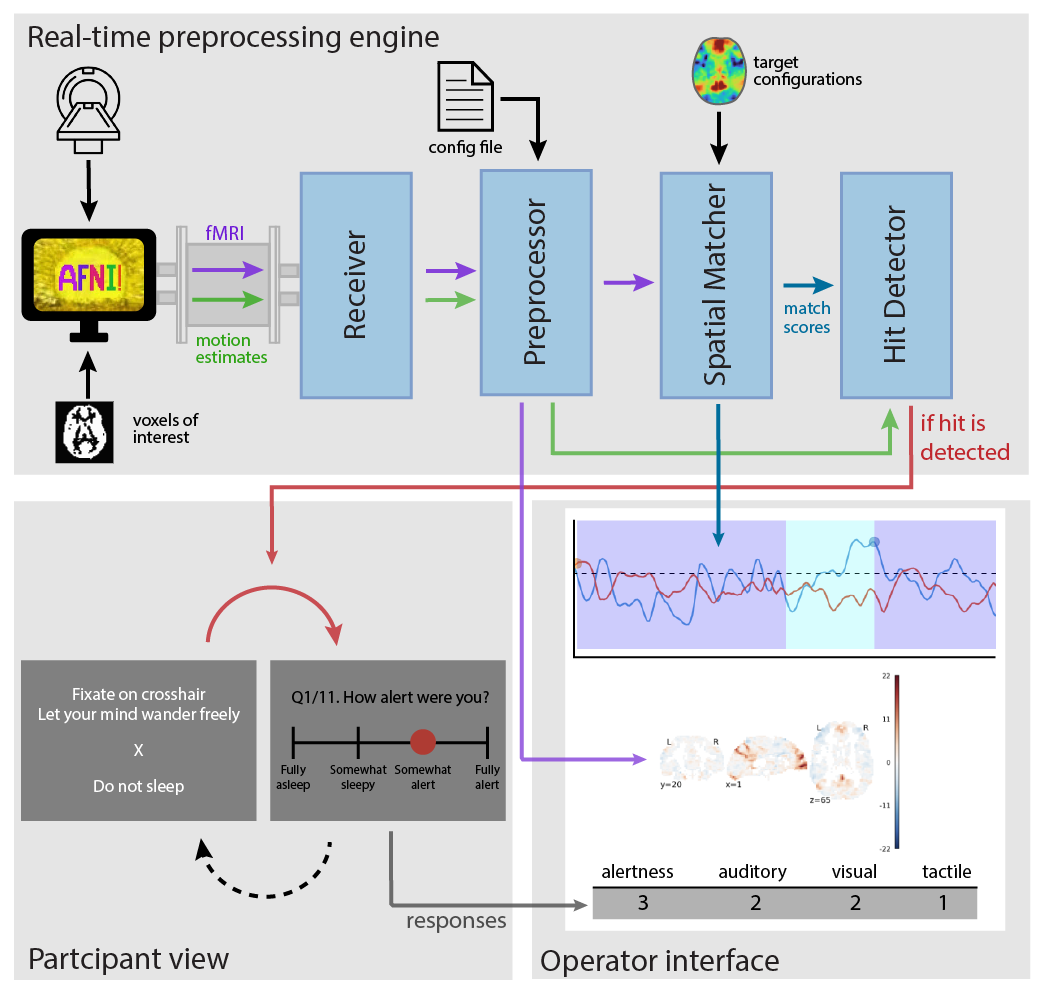
Overview of the rtcog multiprocessing architecture.
The preprocessing engine
rtcog builds on AFNI’s real-time fMRI infrastructure, which streams image data
directly from the scanner on an TR-by-TR basis. AFNI performs initial processing,
including DICOM-to-NIfTI conversion and online volume registration. Each acquisition
is then transmitted to rtcog via a socket connection for further processing.
The Pipeline
Within rtcog, incoming volumes pass through a configurable preprocessing
pipeline that may include spatial smoothing, normalization, and other user-defined
operations. The preprocessing pipeline is designed to be modular and extensible.
Preprocessing step parameters can be modified via a configuration file. New steps
can also be easily created (refer to Creating preprocessing steps).
Pattern Matching and Detection
After preprocessing, each volume is compared against user-defined activation
templates to detect neural patterns of interest. rtcog currently provides two
pattern-matching approaches:
Region-of-interest–based matching, which evaluates activation levels within specified regions.
SVR-based matching, which uses a support vector machine trained on previous data to detect activation patterns.
A hit is registered when the similarity between a TR and a target template exceeds user-defined criteria (e.g., the score exceeds a certain threshold for a specified duration). Hits can be used to trigger downstream experimental action, such as survey presentation or feedback delivery.
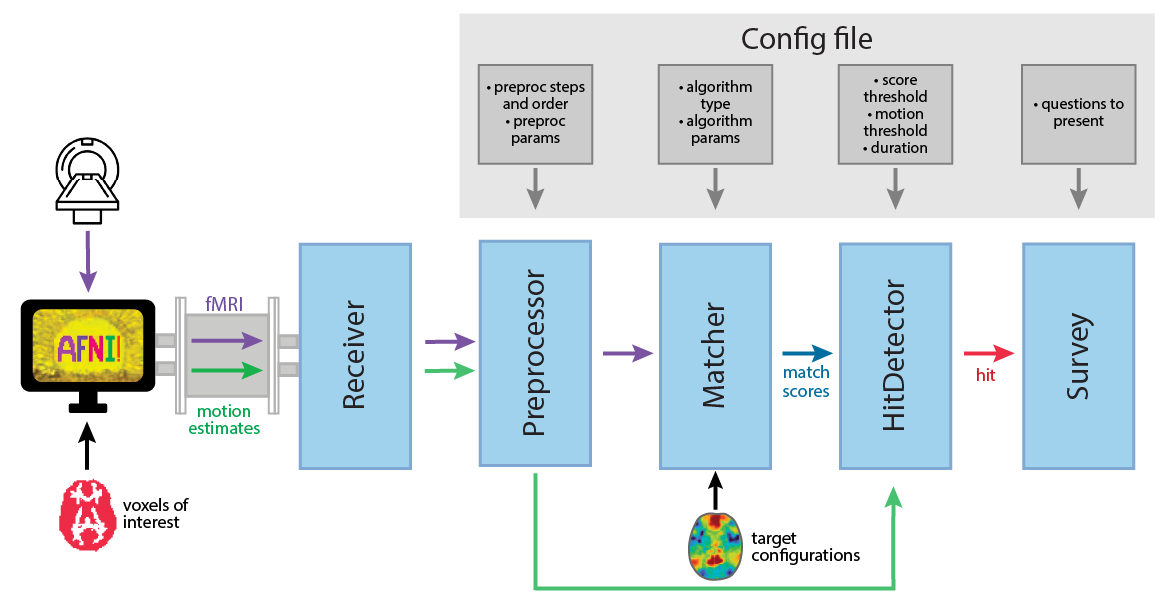
Detailed view of the preprocessing engine.
Experimental Control and Visualization
When a hit is detected (i.e., when a TR matches a target template), rtcog can
automatically initiate experimental actions during ongoing scanning. Survey
presentation and participant response logging are handled through integration with
PsychoPy, enabling time-locked introspective or behavioral probes.
For real-time monitoring and quality assurance, rtcog integrates with the
HoloViz visualization framework to provide live displays of neural signals,
pattern-matching scores, and experiment state.
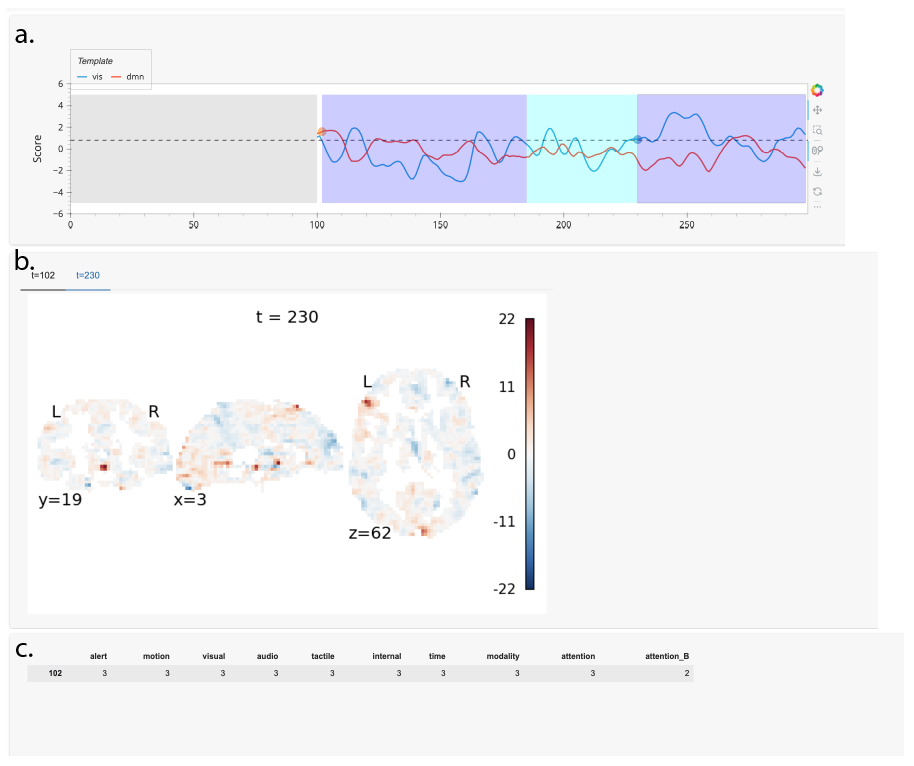
Screenshot of the operator’s view, which is updated in real time as new data comes in. The interface consists of three parts: (a) The match (similarity) score between each brain volume and each template; (b) The subject’s brain activity each hit; (c) The subject’s behavioral survey responses at each hit.
Extensibility and Use Cases
rtcog is designed to be extensible at multiple levels, including preprocessing,
pattern matching, and experiment control. New processing steps, matching algorithms,
and experiment modes can be added with minimal changes to existing code.
This allows rtcog to support a wide range of real-time neuroimaging applications,
including:
Monitoring spontaneous thought and internal cognition
Real-time neurofeedback
Online neuromodulation and clinical research applications
For more information on how to extend rtcog, refer to Customizing Components.